My 2014 trip with Harold to Nebraska to see the sandhill cranes was when I first realized that I was actually going to fulfill my goal of visiting, in a meaningful way, each of the 50 states. As we headed west from Alabama passing through states I had already visited on other trips, my eyes were on Arkansas. We were traversing the heartland, the epicenter of flyover country. I had two stops planned. We spent one day in Hope, boyhood home of Bill Clinton. Then we headed up to Hot Springs and visited the national park. I would say that Arkansas is a worthwhile place to visit, but it is not one of the states to which I absolutely must return someday. Been there, done that.
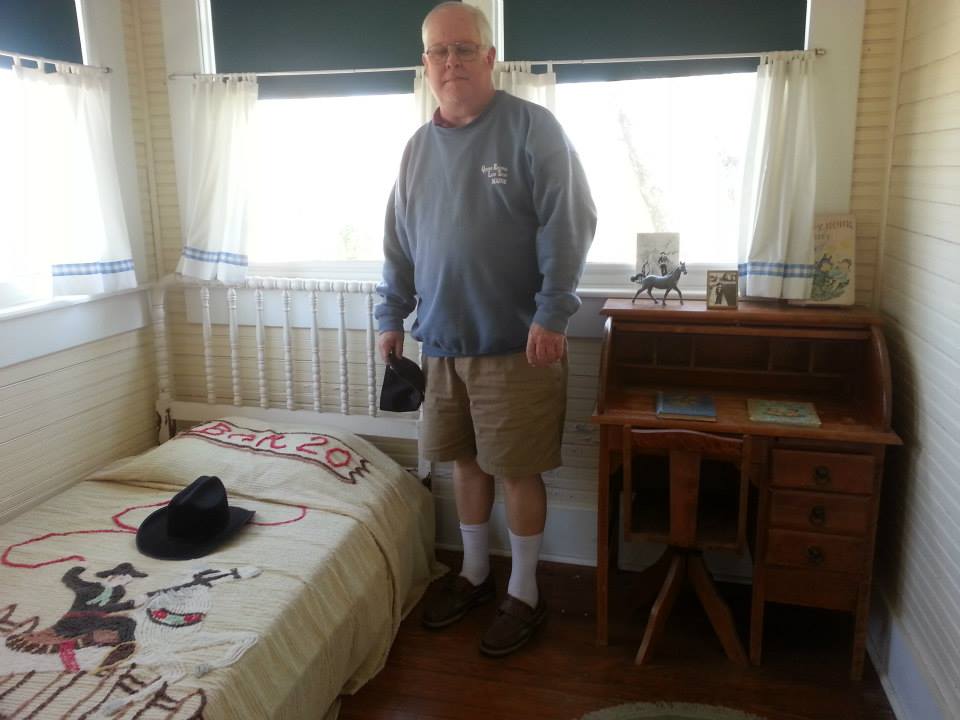
Clinton’s home feels like the kind of home where my friends lived while growing up in Pittsburgh. It is so ordinary as to almost appear as a cliche. A solid brick house on a street of small bungalows in a quiet residential setting describes the scene. Inside the home mementoes from a 1950’s childhood provided a lot of nostalgia for a pair of aging baby boomers. Harold was particularly taken with the Hopalong Cassidy decor in Clinton’s bedroom. Apparently both Bill and Harold were big fans. I became enthralled by the ordinariness of it all. His mother’s dressing table could have belonged to my mother or grandmother. It all reminded me of my girlhood home. My daughter Megan believes the picture I took of us in the mirror in the mother’s bedroom is most awkward. She says Dad looks displeased with me and the park ranger in the background appears to be adjusting his underwear. Nevertheless, I like the picture.

After our visit to Clinton’s boyhood home we headed north to Hot Springs and the experience of a lifetime for me. On the other hand Wally and Harold just went for a walk in the park and took their afternoon naps in the motel. I visited the historic Hot Springs and took a dip in an antique porcelain claw foot tub in a screened bathing area. After I got into the tub which had been filled with delightfully hot mineral water from the spring, an attendant came into the cubicle and proceeded to scrub my back with some type of loofah sponge. It was quite delightful. When the experience was over I was wrapped in hot towels and told to lie on a massage table to cool down. In a little while the masseuse entered the private room and gave me a wonderful massage. All of this was courtesy of the National Park Service upon payment of a nominal fee for services. While I was waiting in the lounge area before the procedures commenced two young women from California came in and sat down. They were talking about the reasonable charges for the services rendered and how it would cost 3x times as much in LA.
Hot Springs National Park is a conglomeration of historic architectural structures and natural vistas all located in the middle of a fair-sized town. https://www.nps.gov/hosp/index.htm The architectural heart of the park consists of seven bathhouses constructed between the 1890’s and the 1920’s. I received my spa experience at the Buckstaff Bathhouse which continues to use the tubs and fixtures from the original construction. https://www.buckstaffbaths.com/ One of the bathhouses is named the Lamar Bathhouse after Lucius Lamar who was Secretary of Interior in the 1880’s at the time the first bathhouse was constructed. I found that interesting for three reasons. First, Lamar became a Supreme Court Justice, the first post-Civil War southern Democrat to be appointed. Second, he had previously served in some capacity in the Confederate States of America and he originally opposed Reconstruction and ardently believed in the supremacy of the white race. Apparently his views moderated with the passage of time and he did ultimately support limited black suffrage. Third, and most interesting to me, the Lamar Valley in Yellowstone National Park was named after him when the park was surveyed during his tenure as Secretary of the Interior. You will learn a great deal more about the Lamar Valley when I finally get to Wyoming. My point in this little digression is, as the Canadians and First Nations say, “Ankose” Everything is Connected, Tout est Relie. https://www.gallery.ca/magazine/in-the-spotlight/our-path-forward-as-an-institution-is-ankose
I have always wondered where Arkansas got its name. According to Arkansas Secretary of State’s website, the name “Arkansas” originates with the native American Quapaw tribe “by way of early French explorers. The explorers met a group of Native Americans known as the Ugakhpah (which means “people who live downstream”). These Native Americans later were called the Quapaw, who were also called the Arkansaw. This name came to be used for the land where these Native Americans lived.” All State Name Origins I find this interesting because many “native” names for tribes seem to have come about because explorers talk to neighboring tribes who told them what THEY called the other tribes. That means that the word used to describe the place or the people is not really their own “native” descriptor for themselves, but rather the descriptor given to them by neighboring tribes.
 Memories - A Second Chance at Happiness