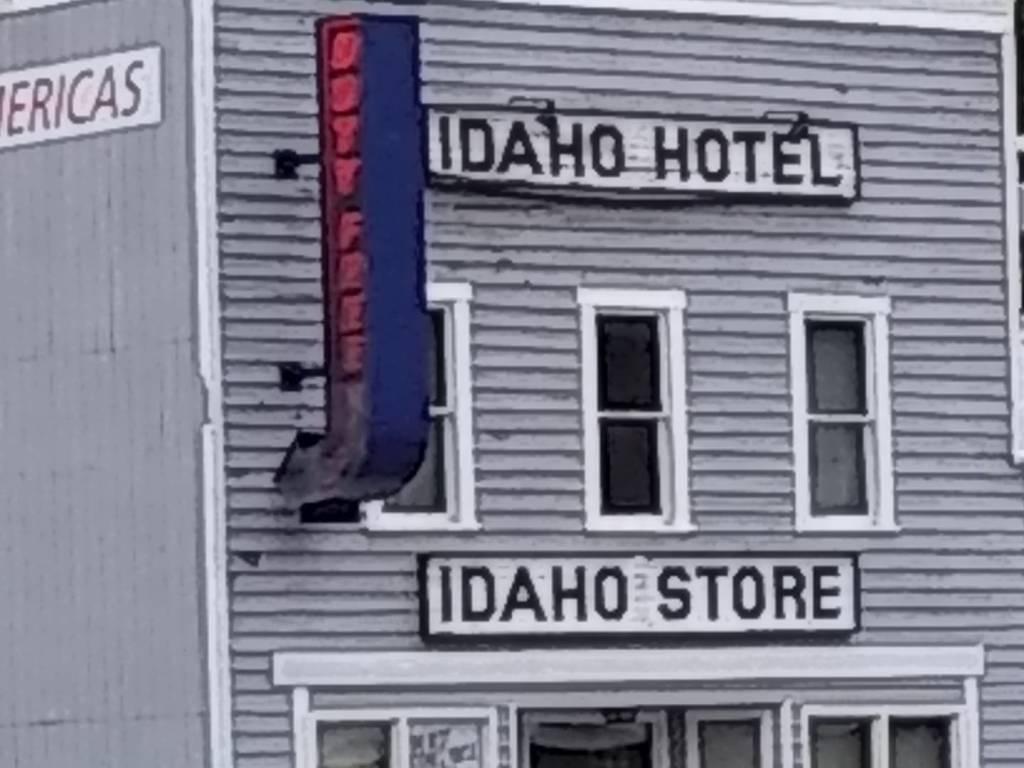
The picture above of the duty free shop was taken in Eastport, Idaho. When you cross the border from British Columbia into Idaho the port of entry in the northeastern corner of the state’s panhandle is known as Eastport. Since my home on Campobello Island in New Brunswick, Canada sits right across the Bay from Eastport, Maine, needless to say I was fascinated when I arrived at the border and found myself in Eastport. I really could not find any connection between this little town and “my” Eastport except they share a common name. I rather suspect this town was named Eastport because there are two separate Ports on Entry on the Idaho/B.C. border at the top of Idaho’s long skinny panhandle and this particular one was the easternmost of the two ports. Not much else can be said about Eastport, Idaho.
After Megan and I visited Glacier National Park, Alberta, and British Columbia, we proceeded south from Eastport into Coeur d’Alene, Idaho, on our circle route that eventually took us back to the train station in Whitefish, Montana. Coeur d’Alene is one of those places I always wanted to visit because I had heard so many glowing reports about the beauty of the town. Everybody’s report was accurate. There is a compact downtown with shops and restaurants opening up to a beautiful park and marina on the lake. There are trails into the foothills overlooking the lake and many opportunities for scenic visas. This link provides a pretty good summary of the many things the city has on offer. https://visitnorthidaho.com/community/coeur-dalene-idaho/ It is ironic that just this year, 2023, the Supreme Court of the United States issued an opinion about the reach of the Clean Water Act that arose in the context of wetlands located in Idaho. They determined that the Clean Water Act did not apply without limitations to wetlands “adjacent” to the waters of the United States. The waters of the United States in that case involved Priest Lake in Idaho. But the new ruling applies to all previously covered “adjacent” wetlands, including the wetlands in proximity to Lake Couer d’Alene. One only hopes that generations to come will be able to enjoy the lakes and streams of Idaho without extreme pollution further degrading the water quality. Extensive mining in Idaho has already taken a toll on many rivers and streams.
Before I turn to the mystery regarding the Salishan language and meaning of Couer d’Alene in French, I will digress for a moment and try to explain the origin of the name Idaho. Wikipedia has a pretty good explanation. https://en.wikipedia.org/wiki/Idaho#Energy Apparently in the early 1860s, when considering organizing a new territory the name “Idaho” was suggested by a politician. He claimed that the name was derived from a native term meaning “the sun comes from the mountains” or “gem of the mountains”, but it was revealed later that there was no such term. The politician then claimed that he had been inspired to coin the name when he met a little girl named Ida. By the time the U.S. Congress ultimately decided to name the area Colorado Territory, the town of Idaho Springs had already been named. Eventually the state boundaries of modern Idaho were carved out of the Washington Territory and the Colorado Territory. I digressed on this point because it provides interesting background for the naming of the town of Couer d’Alene.
It often happens in this country we pretend to be applying native names to places which had very different names before Europeans arrived on the scene. Or we use European place names to mock native culture. Couer d’Alene may be a case in point. It is obviously a French phrase and it roughly translates into the English as “heart of an awl.” What does that mean? An awl is a woodworking tool used to punch small holes. It is believed the name was applied by the French trappers in reference to the native tribe’s practice of piercing the ears of young people with sharpened sticks. Others suggest the name was given to the tribe that lived in the area because of the sharpness of the trading skills of the chief and the rest of the tribe. Whatever reason the French had for first using the name, it did not honor or recognize previously established place names or tribal languages.
The native tribes of the Pacific Northwest spoke over 23 different languages. These Salishan languages were spoken throughout the Pacific Northwest, including British Columbia (Canada), and the U.S. states of Washington, Oregon, Idaho, and Montana. The Coeur d’Alene Tribe Language (snchitsu’umshtsn) is a southern interior Salishan language. The members of the tribe which spoke this language were called Schitsu’umsh and they lived along streams and rivers from eastern Washington State through Idaho and into Montana. Their language is considered endangered although efforts are being made to preserve it through a few elderly native speakers. There is little information available about the original place names of the various bodies of water and mountain peaks in the area. And as you can see from the examples above, the Couer d’Alene tribe’s language is very consonant heavy and quite difficult for speakers of Western languages to pronounce. Sometimes when traveling the most interesting thing to do is to learn about the history of the place in addition to viewing gorgeous scenery, shopping, and eating at interesting restaurants. A small understanding of the native inhabitants gives a fresh perspective and deeper appreciation of an area.
But lest you think Megan and I were all work and no play, I will remind you we were in Idaho after all. We simply had to have a potato encounter. Megan found us a pub where for the happy hour we could get 2 gin and tonics for $3.00. Yes you read that correctly, two drinks for 3 bucks. We also got loaded potato skins, filled with gooey cheese, tomatoes, black olives, hot peppers, and God knows what else, because yes indeed, it was Idaho. The potato skins were delicious and the pub by the lake was a perfect place to relax after a day spent hiking and sightseeing in Couer d’Alene.

 Memories - A Second Chance at Happiness