My all- time favorite book is called “West With the Night” by Beryl Markham. She was a female aviatrix born at the beginning of the 20th century who flew solo, nonstop across the Atlantic Ocean in 1936, the first person to fly from Britain to North America. She crash landed in Cape Breton, Nova Scotia, but survived to become a celebrity in the United States and Great Britain for a brief while. Her memoir, published in 1942, enjoyed modest success. The book faded into obscurity until 1983 when it was reissued and enjoyed enormous success. Markham had been living in near poverty in Kenya and after the republication she was able to live comfortably until her death in 1986. As far as I know she has nothing to do with Iowa, but the first line of the book resonates with my feelings about Iowa. The book begins with the rhetorical question, “How is it possible to bring order out of memory?” Markham proceeds to do exactly that in her beautifully written memoir of her life growing up in British East Africa and eventually flying across the Atlantic Ocean.
This blog is my unsatisfactory attempt to bring order out of memory as I explain early on, trying to chronicle the various states by the date I first made a “meaningful” visit to the state. Fitting Iowa into the niche is a challenge. The last few entries have chronicled my 2014 roadtrip from South Carolina to Nebraska to see the sandhill cranes and to visit many states in the heartland that I might never have visited. Iowa is one such state. It was not until I got to Nebraska that I realized my goal of doing something meaningful in each of the fifty states was within possible reach. Geographically Iowa was the next state I would visit after Nebraska, but our schedule and route of travel would not give us much time for exploring Iowa. However, on this first venture into the state I did discover the Loess Hills. https://www.visitloesshills.org/?fbclid=IwAR07fjXX9mevphQGOoEgyyYMbJhEtlg8-l-S2hTYZ8UpVt5g8lWSYWR5QfQ
Loess is a type of very fine wind blown soil. It is found throughout the world, but the deposits in Iowa are among the highest in the world. They were formed by prevailing winds from the northwest across the particles in the dry riverbed that eventually became the Missouri River and deposited on the easterly side of the river forming a two hundred mile long stretch of hills that stretch down the westerly side of Iowa from Sioux CIty, Iowa to St. Joseph, Missouri. A formation has to be at least 60 feet high to qualify as a Loess Hill and as one drives south heading toward Missouri one travels parallel to and through the hills. There is even a Loess Hills scenic byway if you want to get off the interstate and explore. (Harold had no time for that, his eyes were on Missouri, our next destination.) Since I felt the chances of me ever returning to Iowa were quite minimal, I would have to settle for driving through the Loess Hills as my meaningful trip to Iowa. Alas I would never get to visit the more famous Iowa tourist sites like the Iowa State Fair or the Amana colonies, but I felt that the 2014 drive through would be the extent of my Iowa exploration.
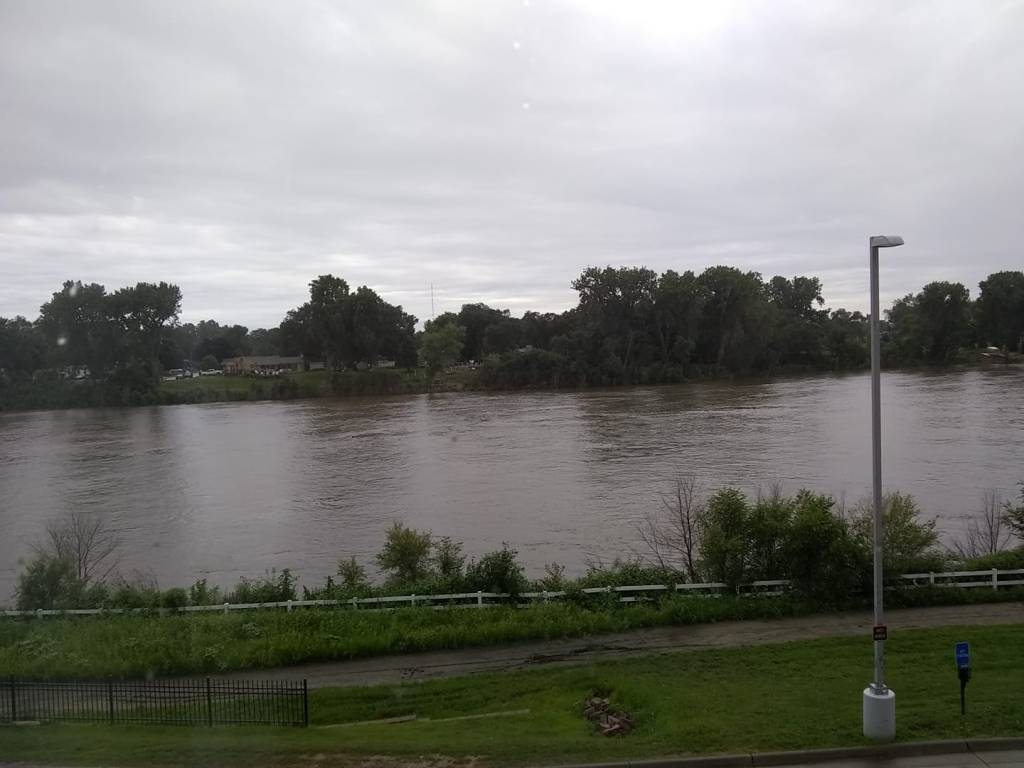
Yet, that is the mystery of organizing memory as Beryl Markham noted. I am compelled to date my first trip to Iowa in 2014, but it was really in 2019 that I wound up having a much more meaningful experience in the state. The picture at the top of the blog was taken in 2019. It is the view from the hotel where my daughter Megan and I stayed in Sioux City, Iowa in the very northwestern corner of the state. I lost Harold at the very end of 2018 and Megan and I headed out on an epic train trip from Seattle to Chicago in July of 2019. Would my memory be better organized if I included Iowa in my description of the week we spent in the Dakotas? Sometimes in organizing this blog I have discounted quick drives through a state from qualifying for my purposes as my first trip to the state. But in the case of the Loess Hills drive with Harold it is a vivid memory. I learned an important fact about loess, a term I had never heard and I saw some extremely interesting landscape features that break up the image of a flat landscape. I think I have legitimately treated my 2014 trip as the first visit although not as meaningful in terms of exploration as the 2019 visit.
The reason for the 2019 visit to Sioux City was that one does not travel across the route of the Missouri River without getting immersed in the culture of Lewis and Clark. We learned a lot about that expedition when we got off the train and explored various spots along the route. That all culminated in our overnight visit to Sioux City, Iowa and the trip to the Lewis and Clark Center located there on the banks of the Missouri River. https://www.siouxcitylcic.com/ The Center commemorates the time the Corps of Discovery spent in the area of Sioux City from July to September, 1804. It was there that Charles Floyd, a member of the Corps died. He was the first soldier to die west of Mississippi and the only member of the entire expedition to die during the journey. It is believed he died from acute appendicitis.
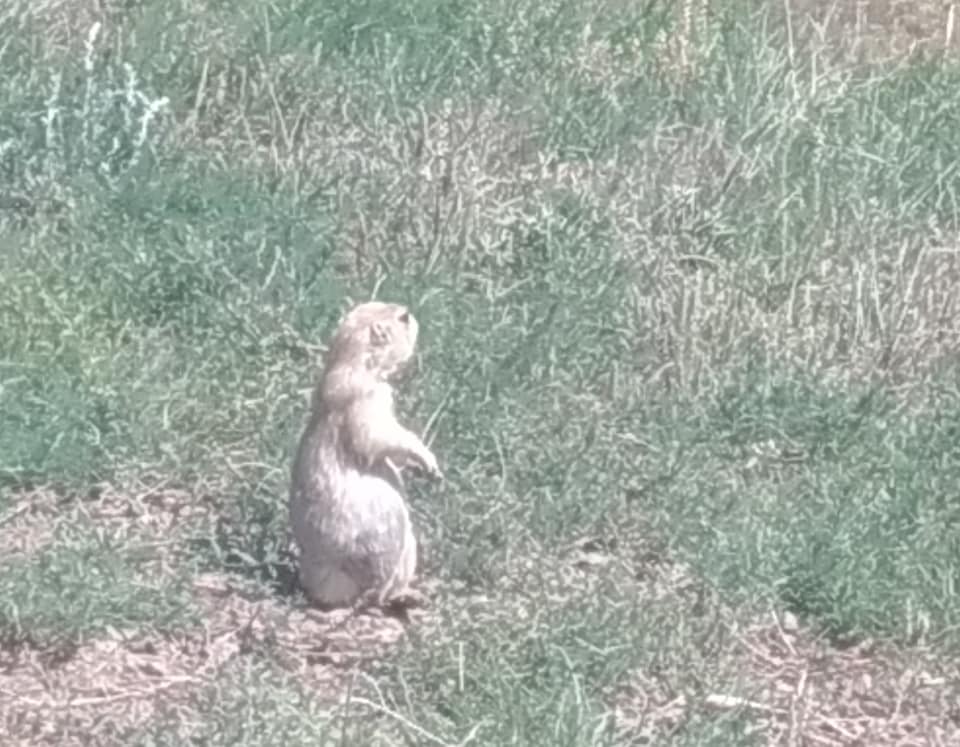
Megan became fascinated with prairie dogs when we visited North Dakota and when she got to Sioux City she was appalled to learn what the explorers had done. Apparently they caught a live prairie dog and put it in a cage and shipped it east to Thomas Jefferson. The prairie dog sailed from New Orleans to Baltimore, and by 12 August 1805, was in Jefferson’s possession. It lived with Thomas Jefferson until 21 October 1805. Jefferson then sent a live prairie dog and magpie and some of the animal skins, skeletons, and horns to Charles Willson Peale, a Philadelphia artist, for the Peale Museum, his public gallery of art and natural history. I could not find a record of the prairie dog’s death, but one can fairly assume he could not have survived too long in Philadelphia. What better way to close this entry than with a picture of a prairie dog taken by Megan?
 Memories - A Second Chance at Happiness