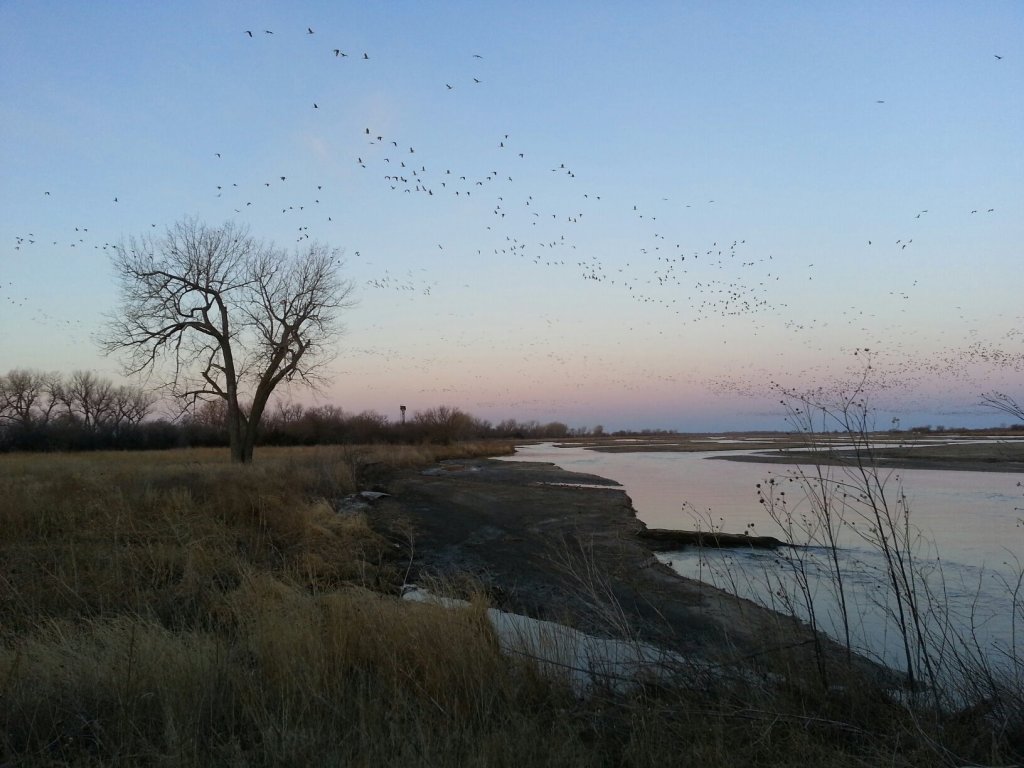
It all started in a bar in Lubec, Maine, in the Fall of 2013. Harold and I were discussing what we would do after I retired and our winter sojourn at Edisto Beach came to an end in March 2014. Harold suggested that we return to Bermuda, scene of our honeymoon in 1979, but I revealed that my heart’s desire was to travel to Nebraska and view the sandhill cranes on their migration from Mexico to the tundra in Alaska and Canada. Thus in early March 2014 Wally, Harold and I left Edisto Beach and headed west and north to reach the Rowe Audubon Sanctuary by March 15th. We had made a reservation to hike out to a blind on the Platte River where we would watch the sunrise and the sandhill cranes, almost 100,000 of them, lift off the Platte River in the breaking daylight. It was truly the experience of a lifetime. I am not the only person who has been captivated by the sandhill cranes. Many people, including Jane Goodall, return to witness the migration each year. There is something magical about witnessing the migration. For those who have been enchanted by the cranes, the yearly migration is something that calls for a yearly return. https://www.hppr.org/holiday-special-programming/2012-10-26/sandhill-song?fbclid=IwAR1c3XHxYbrJusaAT-F642Xctydsiw-kCkpWt2YlPD3qgzqVook-Fk1gxTk (If you click on the link make sure you scroll to the bottom and listen, too, not just read the article.) I personally love this quote from Charles Kuralt, “I saw them first many Novembers ago and heard their triumphant trumpet calls, a hundred or more sandhills riding south on a thermal above the Rio Grande Valley, and that day their effortless flight and their brassy music got into my soul.” Witnessing the sandhills is both an optical and an auditory experience. The cacophony of the flock as they roost in shallow water, graze in open fields or soar overhead is like nothing else I have ever heard. Part of the mystique of the sandhills is the simple fact that the cranes’ migration has existed for close to ten million years. Many anthropologists believe human beings have only been in North America for 13,000 years. The ancient pattern of the migration of the cranes, their tight family units, and their ability to communicate within the flock all feed the endless fascination.
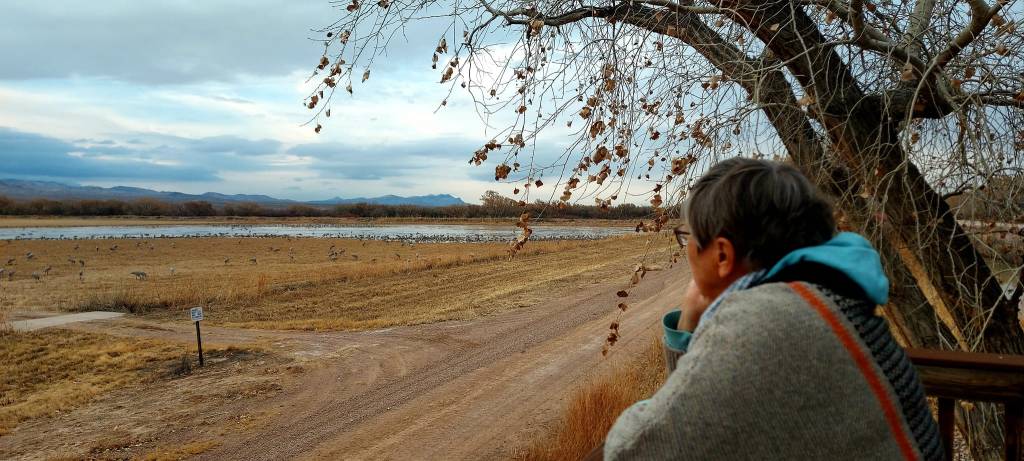
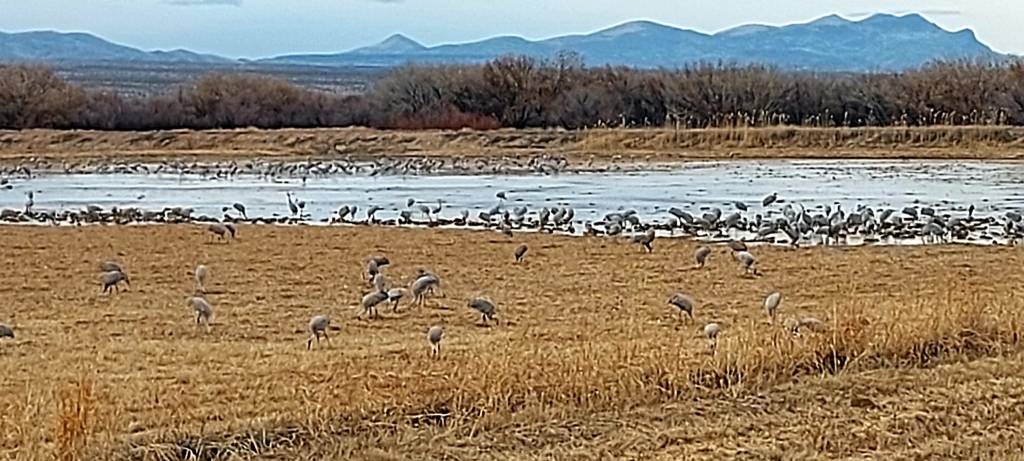
My visit to the sandhill cranes in 2014 was not a one-time venture for me. Although I have not returned to the Platte River, in 2022 at Christmas I ventured to New Mexico and visited the Bosque del Apache, wintering grounds for many of the Greater Sandhills and the Lesser Sandhills as well. (The Lesser Sandhills, which are only slightly smaller and hard to distinguish from the others, are the cranes who undertake the arduous migration to the tundra.) Although Megan and I saw hundreds of sandhills in the Bosque, it was nothing like the thousands that I witnessed on the Platte River. Nevertheless, we went out to the Bosque at sunrise and sunset to watch the cranes at their most active, when leaving or landing in the shallow water where they roost overnight. Predators, like coyotes, apparently do not like to get their feet wet. The pictures below are from New Mexico not Nebraska but they do demonstrate my continuing devotion to the sandhill cranes, as I ponder them as they prepare to roost for the evening in a shallow pool on the Bosque.
Lest you think the entire trip to Nebraska was about cranes, there are a couple of other interesting things we encountered. Kearney (not pronounced the way you think it would be) is a lovely college town with good brew pubs, parks and bike trails. No trip to Nebraska would be complete without a visit to the Great Platte River Road Archway over Interstate 80. https://archway.org/ It really is a fascinating museum built across the interstate and traces the history of the roadway from the days of the Oregon Trail to the present. For me the most interesting exhibit centered on the Lincoln Highway which followed the same route as the Oregon Trail and the Pony Express. It was started prior to the First World War and became the first transcontinental highway for automobiles. In 1913 the original highway was paved with bricks and some of those bricks are preserved in the museum. Many times we eschew corny roadside attractions like this museum built in an archway over the interstate, but in this case I am glad Harold decided to spend the money to get us tickets for a visit. Even if you don’t find the museum exhibits particularly interesting, in the middle of the archway there is an observation point where you can look down on the cars speeding both ways of Interstate 80. It is fun to contemplate the lives being lived in those vehicles as they speed from God knows where to someplace else.
Before I leave Nebraska I have to describe my other love that dwelt for at least part of her life on the plains. Red Cloud was the girlhood home of Willa Cather, one of my favorite authors and, I believe, the most underrated Great American Writer. We approached Red Cloud from the south, traveling through Kansas and across the Willa Cather Memorial Prairie, 612 acres of never plowed native prairie located about 5 miles south of Red Cloud. https://www.willacather.org/learn/cather-prairie In Cather’s writing she often describes the prairie as much like the sea, constantly moving and containing the undulations of waves washing onto the shore. She once described the prairie as follows, “that shaggy grass country” which “gripped me with a passion I have never been able to shake.” Although she moved to the prairie as a young girl and left the prairie when she went to university and then to work in Pittsburgh, Pennsylvania, obviously her years living there were her formative years and her best known works, the so-called “Prairie Trilogy,” which includes O Pioneers!, Song of the Lark, and My Antonia, take place on the Nebraska prairie. If you have not read any Cather novels, she is an American writer well worth reading. I think the best way to end this post is not with a song or a photograph, but with a poem by Cather that speaks to the unique beauty of the prairie and her ability to become part of the landscape.
Prairie Spring
Willa Cather – 1873-1947
Evening and the flat land,
Rich and sombre and always silent;
The miles of fresh-plowed soil,
Heavy and black, full of strength and harshness;
The growing wheat, the growing weeds,
The toiling horses, the tired men;
The long empty roads,
Sullen fires of sunset, fading,
The eternal, unresponsive sky.
Against all this, Youth,
Flaming like the wild roses,
Singing like the larks over the plowed fields,
Flashing like a star out of the twilight;
Youth with its insupportable sweetness,
Its fierce necessity,
Its sharp desire,
Singing and singing,
Out of the lips of silence,
Out of the earthy dusk.
 Memories - A Second Chance at Happiness