As I mentioned in my Arkansas post, it was after I retired in 2014 that I became serious about completing my 50-state quest. Since I was headed on an epic road trip from South Carolina to Nebraska it became obvious that many states that may otherwise have truly been nothing but flyovers to me could be visited. I have already told you about Alabama and Arkansas visits, but Oklahoma was a real challenge for me. What could I possibly do in Oklahoma? Then I remembered Woody Guthrie. We put Tulsa into the GPS and we headed toward The Woody Guthrie Center https://woodyguthriecenter.org/ a gem located in downtown Tulsa. It was not a mistake. We spent the better part of a day in the museum, listening to music and learning all about an amazing life. If I were to return to Tulsa now, I would find even more to do. In 2022, eight years after my visit, the Bob Dylan Center opened just down the street from Woody’s museum. https://bobdylancenter.com/visit/ I can’t tell you much about Dylan’s museum except what you can read in the link.
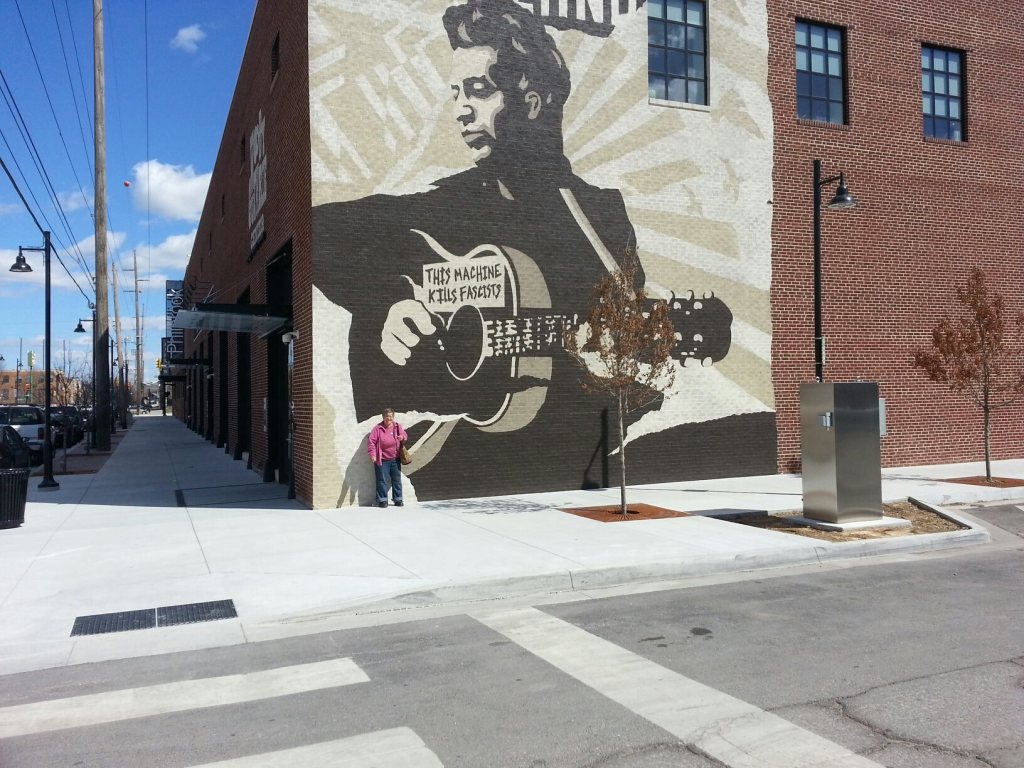
I do have this one picture to prove I was actually in Tulsa. Poor Harold had to go all the way across the street to get the entire mural into the picture. This fact reduced my image to a pretty small dot, but believe me, there I am in Tulsa, Oklahoma enjoying myself immensely.
If I were to return to Tulsa someday I now know many more things about the history of the city that I would explore. Since 2014 and taking up my winter residence in Charleston, South Carolina, I have become extremely interested in Afro-American aspects of American history. I believe that my generation, the so-called “Baby Boomers,” received educations that “whitewashed” American history. I had never heard of the Tulsa Race Massacre until 2020 when our country was torn apart by the murder of George Floyd at the hands of a white police officer. At that point I started to seriously study the history of race relations in the country and to understand that the civil rights struggle did not begin and end in the 1960’s with Martin Luther King. The history of Birmingham and Selma was known to me because I lived those incidents as current events during my school years. Walter Cronkite informed me on the evening news about events in Mississippi and Alabama. What I did not know or understand was all the historical events that went before or followed after the height of the Civil Rights Movement. The Tulsa Race Massacre is an important part of American history never taught in the schools during my formative years. https://www.okhistory.org/learn/trm4 Tulsa’s Greenwood neighborhood was a successful Black community, its main street had the moniker Black Wall Street. Today you can take guided tours of the area and visit museums and cultural sites that preserve the history. https://www.tulsa.tours/greenwood-black-wall-street-tour The Greenwood Cultural Center does a great deal to preserve the cultural heritage of the Greenwood area. https://www.greenwoodculturalcenter.org/ If I were to return to Oklahoma, visits to these sites would be high on my list of things to do. The Greenwood neighborhood was almost completely destroyed by the rioters and looters and the 1921 Tulsa Race Massacre, fueled by white looters and vigilantes, is still widely regarded as the most violent racial incident in American history. The precise number of people killed is a moving target, but at least 37 direct victims have been identified. The local Tulsa paper, the day after the incident, reported the death toll as at least 100. Efforts are ongoing in an attempt to associate newly unearthed remains with mass graves connected to the race riot.
I would not mind if someday my travels took me back to Tulsa. Certainly the state is not as relaxing and scenic as the hot springs at the national park in Arkansas. Nor was Tulsa as beautiful as the Platte River in Nebraska when thousands of sandhill cranes rose up in a huge cacophony in the early morning dawn. Nevertheless, just like the other forty-nine states I have visited, I made good memories traveling through Oklahoma, where the wind goes sweeping down the plains. It appears, at least, that the state has finally found a productive use for all that wind. https://theoklahoma100.com/business/2020/02/05/oklahoma-wind-power/15410 The stereotype of oil wells drilling away will soon be replaced with the new image of giant turbines turning on plains generating power for the nation.
 Memories - A Second Chance at Happiness